Why a Rest Day After a Late Night Recovers Far Less Than One After an Early Night
Quick Answer: Most of the physiological repair a rest day is meant to deliver happens during sleep, particularly deep sleep in the first half of the night. A rest day following a short or disrupted night gives you the absence of training without the recovery process that makes the absence useful. If you know a late night is coming, schedule the rest day for the day after the night you actually slept - and treat a bad night as a reason to make the next training day lighter rather than to add a second rest day.
You took the day off and still felt wrecked.
The day off was never the active ingredient.

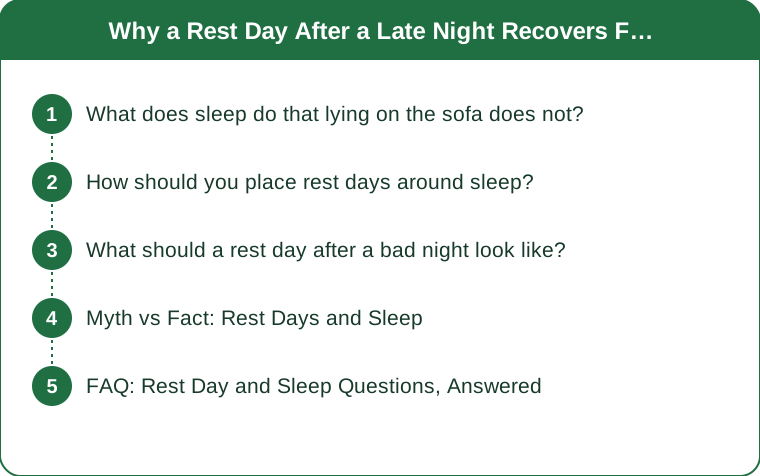
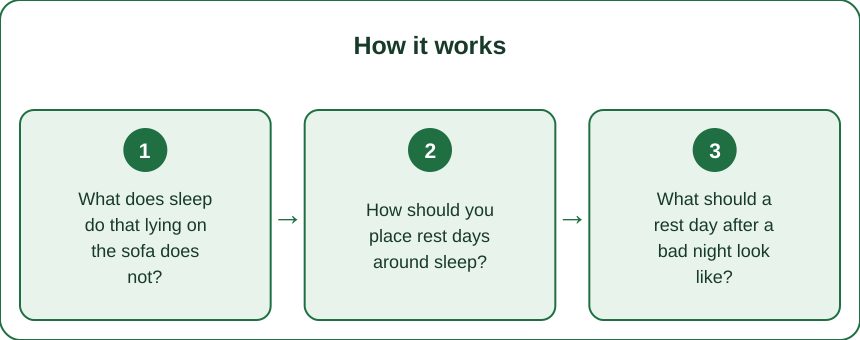
What does sleep do that lying on the sofa does not?
Growth hormone release is strongly concentrated in the deep sleep of the first part of the night, and it is central to tissue repair processes.
Deep slow-wave sleep is where the largest share of physical restoration is thought to occur, which is why a short night hits recovery harder than a fragmented late-morning lie-in compensates for.
Protein synthesis, glycogen restoration and the clearing of training-related fatigue all proceed during sleep rather than merely during inactivity.
Sleep restriction has been repeatedly associated with reduced performance, slower reaction time and higher perceived effort the following day - all things a rest day is supposed to fix.
Immune function and inflammation regulation also track sleep, which matters more in a heavy training block than most people account for.
So the rest day is permission for the process; sleep is the process. Removing training and removing sleep at the same time leaves you with neither.
How should you place rest days around sleep?
Put the rest day after the night you slept well, not after the night you did not. This inverts what most people do.
If you know Friday will be a late night, Saturday is a poor rest day - Saturday is a good light training day, and Sunday, after a full night, is the better rest day.
A rest day following a red-eye or a disrupted night is a rest day spent on sleep debt rather than on training recovery, which is a legitimate use but does not do the same job.
Two consecutive rest days after two bad nights can be better than spacing them out, because the second night is where the actual repair happens.
Look at your week honestly - most people have one predictable late night, and building around it costs nothing.
And after travel, the first day back is about sleep, not training, which is a different category from a normal rest day.

What should a rest day after a bad night look like?
Walk. Twenty to forty minutes, outside, ideally in morning light, which supports the following night rather than the current day.
Do not nap late in the afternoon if the goal is to fix tonight’s sleep. A short early-afternoon nap is fine; a long late one is not.
Eat normally rather than under-eating. Appetite regulation is disrupted by short sleep, and under-eating on a rest day after a bad night compounds fatigue.
Keep caffeine to the morning, since its effects persist for many hours and short sleep makes people load more of it.
Do not add a hard session to compensate for feeling sluggish. Perceived effort is elevated after short sleep, so the session will cost more and deliver less.
Get outside early. Morning light exposure is one of the more reliable levers on sleep timing.
And treat the next training day as reduced by default - lighter load, same movements. This is general information, not medical advice.
Myth vs Fact: Rest Days and Sleep
Myth: a rest day is a rest day regardless of how you slept. Fact: most of the repair a rest day is meant to enable takes place during sleep. Without the sleep, you have the gap in training but not the process that fills it.
Myth: you can catch up on sleep at the weekend. Fact: some recovery of alertness happens, but the evidence that weekend catch-up fully reverses a week of restriction is weak, and it also shifts your body clock so Monday is worse.
Myth: lying in bed awake still counts. Fact: rest and sleep are not equivalent physiologically. Time in bed is not the variable; sleep stages are.
Myth: a nap replaces lost night sleep. Fact: naps genuinely help alertness and are worth taking, but deep sleep concentrated early in the night is difficult to replicate in a twenty-minute afternoon nap.
Myth: if you feel fine, you slept enough. Fact: perceived alertness recalibrates to chronic short sleep, and people routinely underestimate their own impairment. Performance measures decline before people notice.
Myth: training hard will help you sleep better tonight. Fact: moderate activity does support sleep, but a hard session late in the evening on an already-short night tends to work against it.
FAQ: Rest Day and Sleep Questions, Answered
Does a rest day help if I barely slept?
Partially - it prevents adding load - but the repair processes that make rest days valuable happen mostly during sleep. Expect less from it and prioritise tonight’s sleep.
Should I take an extra rest day after a bad night?
Usually a lighter training day plus a strong sleep effort works better than a second full rest day, because the following night is what actually restores you.
Is a nap worth it after a short night?
Yes, and keep it short and early - around twenty minutes, before mid-afternoon - so it does not undermine tonight’s sleep.
Why am I hungrier after a bad night?
Short sleep is associated with disrupted appetite regulation and higher intake the next day. Eating normally, with adequate protein, is more useful than restricting.
Should I still walk on a rest day after a bad night?
Yes. A twenty to forty minute walk, ideally in morning light, supports both recovery and the following night’s sleep.
How do I plan rest days around a known late night?
Schedule the rest day after the night you expect to sleep well, and make the day after the late night a light training day instead. This is general information, not medical advice.
TL;DR:
- Most of what a rest day is meant to deliver happens during sleep, not during inactivity.
- Deep sleep early in the night carries a large share of physical restoration.
- Schedule rest days after nights you sleep well, and make the day after a late night a light training day.
- A short early nap helps; a long late one undermines tonight’s sleep.
- Walk in morning light on a rest day - it supports the following night.
- Expect elevated perceived effort after short sleep and plan the next session lighter.
The rest day is the container; sleep is the contents. This is general information, not medical advice.
Keep Reading
This article is for general informational purposes only and is not medical advice. Always consult a qualified health professional for guidance specific to you.