Why a Rest Day Spent on Your Feet Recovers Less Than One Spent Sitting
Quick Answer: Recovery is limited by total load, and standing all day is load. Prolonged standing produces continuous low-level muscular work in the calves, hips and low back, plus venous pooling and fluid accumulation in the legs. A rest day spent on your feet for eight hours can leave you feeling worse than a light training day, because the legs never actually stopped working. Match the rest day to the rest of your life, not just to your training schedule.
This is why rest days sometimes seem to do nothing.
The day was labelled rest. Your legs did not get the memo.

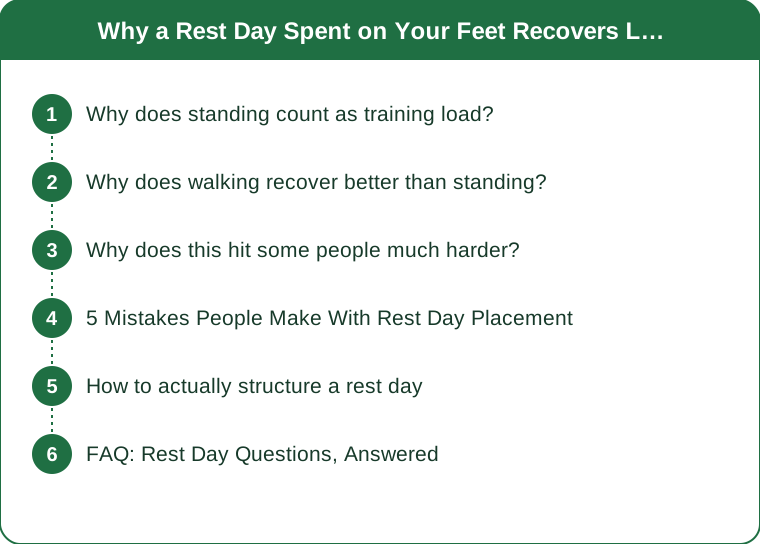
Why does standing count as training load?
Because it is continuous submaximal work, and continuous is the operative word.
Standing still is not passive. Maintaining an upright posture requires low-level, constant activity in the calves, glutes, hip stabilisers and spinal muscles — nothing intense, but with no rest intervals at all. Over eight hours, the total work done is substantial, and unlike a training session there is no recovery between efforts.
There is a circulatory cost too. When you stand for long periods, blood and fluid pool in the lower legs because the muscle pump that normally returns it is only working intermittently. That is why legs feel heavy and swollen after a long day standing, and why the effect is worse when you stand relatively still — retail, teaching, a long day at an event — than when you are walking.
So a rest day that involves a full shift on your feet is not zero load. It is a moderate, sustained, unstructured load applied to the same tissues that are trying to recover, which is a considerably worse combination than a short, sharp load followed by hours of genuine rest.
Why does walking recover better than standing?
Because movement drives circulation and standing still restricts it.
This is the distinction people miss, because both look like being on your feet. Walking rhythmically contracts the calves, which pumps blood and lymph back up the leg. That is why a 20 to 30 minute walk is one of the most reliable ways to reduce soreness and stiffness.
Standing still does close to the opposite. The muscles hold a sustained contraction without cycling, the pump does not operate, and fluid accumulates.
The practical hierarchy on a rest day, from best to worst for the legs:
- Easy walking, broken up across the day
- Sitting with periodic movement — up every half hour or so
- Sitting still all day — better than standing, worse than walking
- Standing still for hours — the worst of the options
This is the resolution of an apparent contradiction: rest days need walking, not nothing — and yet a day on your feet recovers poorly. The variable is movement, not upright time.
Why does this hit some people much harder?
Because rest days are usually scheduled around training and not around the rest of life.
Someone with a desk job gets a genuine rest day when they take one — they sit, they move a bit, the legs recover. Someone who works a shift on their feet gets a day off training that is physically busier than their training days.
Nurses, teachers, hospitality staff, retail workers, hairdressers, parents of small children — all of them routinely take a rest day that involves more hours of standing than a training day does. And then they wonder why the next session feels flat.
The pattern to look for: if your legs feel heavier after a rest day than after a training day, the rest day is not the problem in itself. The arrangement of your week is.
The fix is not to train more or rest more. It is to put the rest day where your life is also restful — which is often not the day the programme suggests.

5 Mistakes People Make With Rest Day Placement
1. Scheduling the rest day on the busiest day of the week. It is the intuitive choice — you have no time to train anyway — and it means you never get an actual recovery day.
2. Assuming a day off training equals a day of rest. These are different things and the calendar cannot tell them apart.
3. Treating a long day on your feet as free. It is not free. It costs recovery, and it should be accounted for like any other load.
4. Doing all the household jobs on the rest day. Six hours of cleaning, standing and lifting is a training session with no warm-up and no programme.
5. Never elevating. Ten minutes with legs up against a wall does more for heavy legs after a standing day than any amount of stretching — and it is the thing almost nobody bothers with.
How to actually structure a rest day
Around the load you cannot avoid.
If your rest day involves a lot of standing:
- Break it up. Sit for five minutes every hour where possible
- Walk properly rather than standing still, whenever you have the choice
- Elevate your legs for ten minutes in the evening — above heart level
- Consider compression socks for long standing shifts; they are genuinely effective for the fluid side
- Expect the next session to feel slightly flat, and plan it accordingly
If you can choose which day is your rest day:
- Put it on the day your life is quietest, not the day your training schedule suggests
- If your busiest day is Saturday, do not make Saturday your rest day — train earlier in the week and rest Sunday
If you cannot choose:
- Treat a standing rest day as a light day rather than a rest day, and make sure at least one genuinely restful day exists somewhere in the week
- Prioritise sleep on those days above everything else
The general principle: your body does not distinguish between load from training and load from life. It only counts the total.
This is general information, not medical advice. Persistent leg swelling, or swelling in one leg only, should be assessed by a doctor.
FAQ: Rest Day Questions, Answered
Is sitting all day actually good for recovery?
Better than standing all day, worse than moving regularly. Prolonged sitting has its own costs — stiffness, reduced circulation — so the target is neither extreme. Sitting with a walk every hour or two is close to ideal.
How do I know if my rest day is working?
The session after it. If your first session back consistently feels flat or heavy, your rest day is not delivering rest, and the arrangement of your week is the first place to look.
Do compression socks help after a standing day?
For the fluid accumulation and the heavy-leg feeling, yes — this is one of the better-supported uses for them. For muscle recovery from training specifically, the evidence is more mixed.
Should I train on my desk day and rest on my standing day?
If you have the choice, the opposite is usually better — train on the day you are already moving and reasonably warm, and rest on the day you are seated. But consistency matters more than optimisation, so the version you will actually do wins.
TL;DR:
- Standing is continuous low-level load with no rest intervals, and it costs recovery
- Walking helps because it drives circulation; standing still restricts it
- People with jobs on their feet routinely take rest days that are physically busier than training days
- Place the rest day where your life is quietest, not where the programme suggests
- Elevate your legs for ten minutes after a long standing day
If your rest days have stopped feeling restorative, look at what you actually do on them before you change your training. Your body is counting the total, and it does not care which part of it was on a programme.
Keep Reading
This article is for general informational purposes only and is not medical advice. Always consult a qualified health professional for guidance specific to you.