The Difference Between a Rest Day You Need and One You're Just Avoiding
Quick Answer: A genuinely needed rest day usually comes with physical signals — persistent soreness, elevated resting heart rate, or noticeably reduced strength — while an avoidance day is typically driven by low motivation alone, with your body otherwise feeling normal.
‘Listen to your body’ is good advice that’s easy to misuse when the body’s only complaint is that the couch sounds better than the gym.

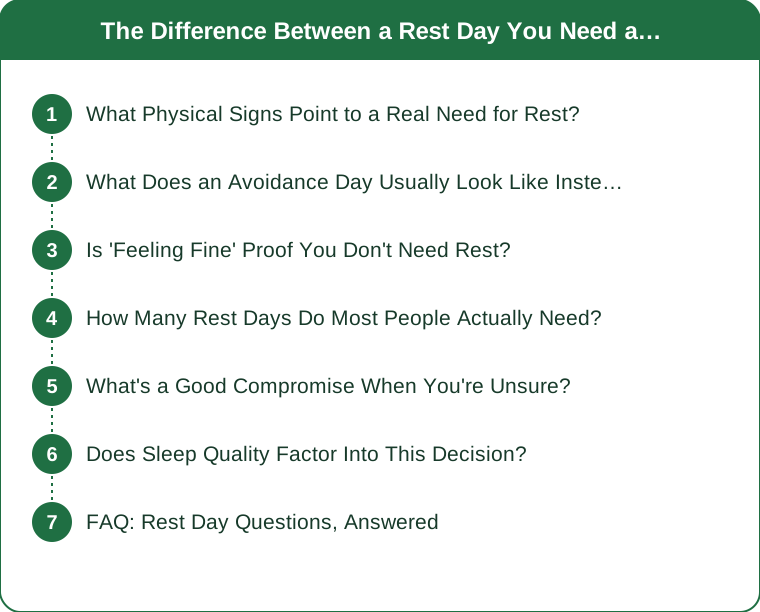
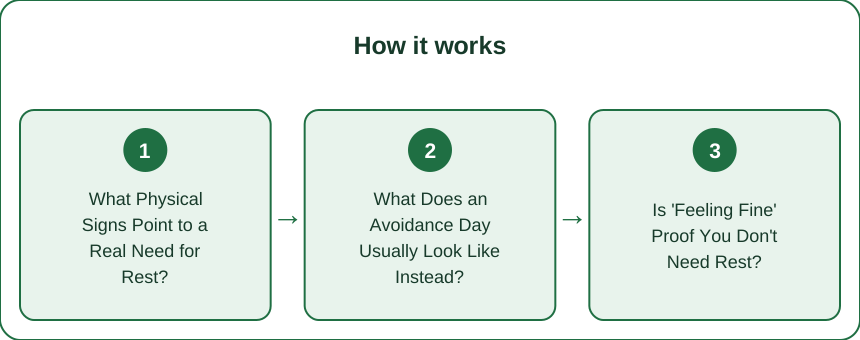
What Physical Signs Point to a Real Need for Rest?
Resting heart rate elevated by 5-10+ beats above your normal, soreness that hasn’t eased after 48 hours, or a noticeable drop in your usual lifting weights or running pace are all legitimate signals your body needs recovery, not motivation.
What Does an Avoidance Day Usually Look Like Instead?
Low motivation with no physical symptoms — you feel capable once you actually start moving, your heart rate and sleep were normal, and the resistance was purely mental. This is common and doesn’t mean something’s wrong; it just means the day calls for showing up anyway, even at reduced intensity.
Is ‘Feeling Fine’ Proof You Don’t Need Rest?
Not entirely — some recovery needs (like accumulated training stress across a week) build gradually and don’t always announce themselves as acute soreness. Scheduled rest days, independent of how you feel that morning, still serve a real physiological purpose in a training plan.

How Many Rest Days Do Most People Actually Need?
For moderate training volume, 1-2 full rest days per week is a reasonable baseline, with more needed during higher-intensity blocks or when sleep and stress are already compromised.
What’s a Good Compromise When You’re Unsure?
Try a light active recovery session — a walk, gentle mobility work — instead of a full rest day or a full workout. If you feel noticeably better moving lightly, it was likely motivation, not genuine fatigue; if light movement still feels heavy, that’s a stronger signal your body needs the full rest.
Does Sleep Quality Factor Into This Decision?
Yes, significantly — poor sleep the night before is one of the more reliable predictors that a scheduled hard session should be swapped for rest or light movement, even if other signals are ambiguous.
FAQ: Rest Day Questions, Answered
Is it bad to take an extra rest day if I’m not sure I need it?
No — an occasional extra rest day rarely hurts progress, while chronic overtraining has real costs; when in doubt, the safer error is resting.
Can too many rest days hurt my progress?
Yes — consistently skipping scheduled training sessions without physical justification does slow progress over time, which is the actual risk of habitual avoidance.
Should beginners take more or fewer rest days than experienced trainees?
Beginners generally need comparable or slightly more rest, since their bodies haven’t yet adapted to training stress, even though their sessions are often less intense.
TL;DR:
- Real rest need shows up as elevated resting heart rate, lingering soreness, or lower performance
- Pure motivation dips usually come with no physical symptoms at all
- A light active-recovery test can help distinguish the two
- Poor sleep the night before is a reliable signal to scale back
- When genuinely unsure, resting is the lower-risk choice over pushing through
Keep Reading
This article is for general informational purposes only and is not medical advice. Always consult a qualified health professional for guidance specific to you.