Rest Day vs. Deload Week: They're Not the Same Thing (and Mixing Them Up Backfires)
Quick Answer: A rest day addresses short-term muscle and energy recovery from a single hard session, while a deload week reduces training volume and intensity across several days to let accumulated fatigue from weeks of training fully clear — using a rest day when you actually need a deload just delays the same problem.
They sound similar but solve different kinds of tiredness, and confusing them is a common reason people stay stuck feeling flat.

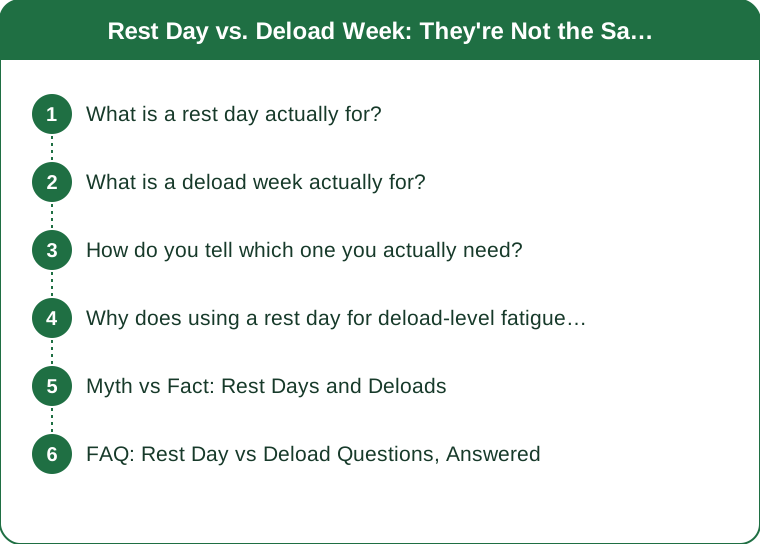
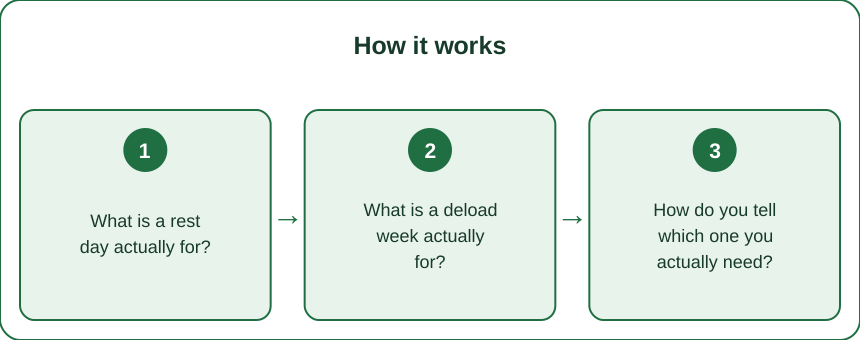
What is a rest day actually for?
A rest day gives your muscles and nervous system a short recovery window from the last one to two hard sessions. It resolves session-level fatigue — the soreness and depletion from yesterday’s workout — but it does very little for fatigue that’s built up over several weeks.
What is a deload week actually for?
A deload reduces training volume and/or intensity (often by 40-60%) for a full week, letting cumulative, multi-week fatigue clear rather than just the last session’s. It’s a planned dial-down, not a full stop, and it addresses a different timescale than a single rest day ever can.
How do you tell which one you actually need?
If you feel wrecked after one hard session but bounce back within a day or two, that’s normal — a rest day covers it. If you’ve felt flat, unmotivated, or stuck at the same performance for two-plus weeks despite rest days, that’s a deload signal, not a single-day one.

Why does using a rest day for deload-level fatigue backfire?
One day off barely dents weeks of accumulated fatigue. You go back into training only slightly recovered, dig the hole a little deeper, and the flat feeling persists — which is often mistaken for needing to train harder, when less volume was actually the fix.
Myth vs Fact: Rest Days and Deloads
Myth: more rest days fix any kind of tiredness. Fact: stacking extra rest days without reducing overall training volume doesn’t address multi-week fatigue the way a structured deload does.
Myth: a deload means doing nothing for a week. Fact: most deloads keep some training at reduced volume and intensity — full inactivity for a week can actually make the return to training feel harder.
FAQ: Rest Day vs Deload Questions, Answered
How often should a deload week be scheduled?
A common approach is every 4-8 weeks of consistent training, though it depends on training intensity and individual recovery — signs of accumulated fatigue matter more than a fixed calendar.
Can a deload week include any hard training at all?
Yes — many deloads keep intensity moderate but cut volume (sets/reps) significantly, rather than eliminating hard effort entirely.
Is soreness a sign you need a rest day or a deload?
Soreness after one session usually just needs a rest day; soreness or flatness that persists across multiple sessions over weeks points toward a deload instead.
TL;DR:
- A rest day clears fatigue from the last session or two; a deload clears fatigue built up over weeks
- Feeling flat for two-plus weeks despite rest days is a deload signal, not a rest-day one
- Using single rest days for multi-week fatigue tends to leave you only partially recovered
- Deloads usually reduce volume and intensity rather than stopping training entirely
If rest days haven’t been fixing the flat feeling, the timescale of the fatigue is probably the mismatch — a deload week addresses a different problem than a day off ever can.
Keep Reading
This article is for general informational purposes only and is not medical advice. Always consult a qualified health professional for guidance specific to you.