Should You Eat Less on Rest Days?
Quick Answer: For most active people, mostly no — rest days are metabolically busy: muscle repair runs one to two days after training, glycogen restocking continues, and the calorie gap between a training day and a rest day is smaller than it feels. Protein should stay identical or even edge up on rest days; carbohydrates can modestly soften if you train intensely and prefer to periodize; slashing intake to punish the day’s inactivity mostly starves the recovery you trained to earn. The useful reframe: you do not eat for today’s workout — you eat for the 48-hour construction project the last one started.
And the rest-day hunger that feels so unfair? Frequently real, delayed, and worth feeding with structure rather than fighting.

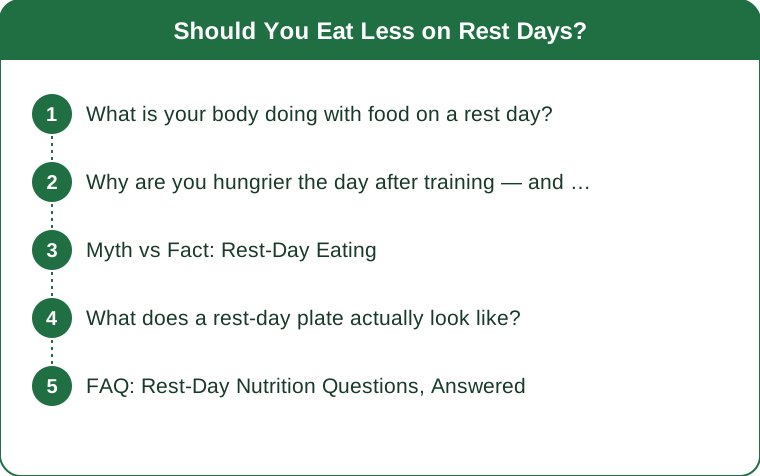
What is your body doing with food on a rest day?
Running the construction phase of the stress-adapt cycle — which is the phase you actually wanted.
Training does not build anything; it creates the argument for building. The response — muscle protein synthesis repairing and reinforcing worked tissue — runs elevated for roughly 24 to 48 hours after a session, which means Tuesday’s workout is still billing materials on Wednesday and into Thursday. A rest day inside that window is not a day off from adaptation. It is the adaptation, in progress, with a materials list.
Protein is the non-negotiable line on that list. Repair draws on amino acids continuously, so rest-day protein stays at your normal target — same total, same sensible distribution across meals. If anything, a modest bump is a defensible choice on heavy-recovery days, and it carries the practical bonus of being the most filling macronutrient on the day appetite management is hardest.
Glycogen restocking is the second project. Hard or glycogen-hungry sessions are not fully repaid at the post-workout meal; replenishment continues across the following day, from ordinary carbohydrate at ordinary meals. Arriving at tomorrow’s session with yesterday’s tank still half-empty is the most common self-inflicted bad workout there is.
Meanwhile, the actual calorie difference between the days is humbler than instinct suggests: a hard hour might add a few hundred calories to a daily total dominated by your baseline metabolism, which runs regardless. The rest day is maybe modestly cheaper — it is nowhere near half price, and the recovery bill is still open.
Why are you hungrier the day after training — and should you fight it?
Because the bill arrives late, and no — you should structure it.
Exercise, especially intense exercise, transiently blunts appetite: post-workout, appetite-stimulating signaling is suppressed and you often eat less than the session cost. The energy gap does not vanish; it queues. The next day — the rest day, with its abundant time near the kitchen — the body submits the invoice, and you experience it as suspicious, unearned hunger on the day you did nothing.
Read it correctly: rest-day hunger after a hard training day is frequently your most honest hunger of the week, delayed billing for work already performed. Treating it as a discipline failure and fighting it flat sets up the classic spiral — white-knuckle restriction through the afternoon, willpower exhaustion by evening, pantry archaeology by nine, then guilt that poisons the next training day. The restriction did not prevent the eating; it rescheduled it into its worst format.
The alternative is structure, not surrender. Real meals at normal times, each anchored with protein and fiber — the two satiety heavyweights — plus genuinely available snacks between them. Hunger met with food that fills tends to resolve; hunger met with refusal tends to compound. Boredom-adjacent grazing does blur in, since proximity to the kitchen is its own appetite — the honest test is whether an apple or some yogurt sounds good. If yes, it is hunger; feed it. If only the interesting food sounds good, a change of room usually answers it.
Hydration runs quieter on rest days too — no water bottle ritual, no sweat prompting — and mild dehydration impersonates hunger with some skill. The visible pitcher earns its keep on exactly these days.

Myth vs Fact: Rest-Day Eating
Myth: Carbs are earned by training and unearned on rest days. Fact: Carbohydrate on a rest day is restocking yesterday’s session and provisioning tomorrow’s — the transaction spans days, not hours. Cutting carbs hard between hard sessions is how heavy legs and flat workouts get manufactured at home.
Myth: Protein matters less when you have not trained. Fact: Repair runs 24 to 48 hours post-session, squarely across the rest day; protein stays identical or nudges up. If one macro were to flex downward on rest days, protein is the last candidate, not the first.
Myth: Rest-day fasting accelerates results. Fact: Layering a large acute deficit onto the recovery window taxes the construction you trained to commission — and reliably degrades the next session. If overall intake needs adjusting, spread it thin across the week rather than dropping it on recovery days; whole-week energy adequacy is the thing training adaptation actually runs on.
Myth: Rest-day hunger is discipline failing. Fact: It is frequently delayed billing for yesterday’s suppressed appetite — physiology, not character. Structure feeds it well; shame feeds it at 9pm from a sleeve of crackers.
Myth: Creatine skips rest days. Fact: Creatine works by keeping muscle stores saturated, which is a daily-maintenance project indifferent to your training calendar. Same dose, every day, whichever days you train.
Myth: A rest day means the couch owes you nothing. Fact: Gentle movement — a walk, easy mobility — supports the day’s actual mission and takes the edge off kitchen-proximity grazing. Rest means no training stress, not no motion.
What does a rest-day plate actually look like?
Nearly identical to a training-day plate — with the adjustments living in the margins, not the middle.
Anchor every meal with protein, spread across the day as usual: eggs or yogurt at breakfast, a real protein at lunch and dinner, an easy option like cottage cheese or a shake on standby. Same target as any other day, doing double duty as satiety management.
Let carbohydrates be normal, sourced slower. If you periodize at all, the rest-day version is quality over quantity-cutting: the fiber-forward carbs — oats, fruit, beans, whole grains — that restock glycogen while keeping fullness long. Athletes with genuinely hard tomorrows should hold carbs steady on purpose; the day before a long run is a filling day, whatever the training calendar says about today.
Add the color and the fat you were too rushed for midweek — rest days are where the vegetables, olive oil, and actual cooking happen anyway. Lean into that: the unhurried day is the natural home of the week’s best meals, not its most punished ones.
Keep the water visible, per the impersonation problem above.
And grant the day its texture: the rest-day uniform of buttery-soft leggings and the good breakfast is not a moral hazard — recovery includes the nervous system, and a fed, unhurried, low-stress day is doing legitimate work on it. The plate does not need to be smaller. It needs to be as deliberate as the training that made it necessary.
Individual targets vary with training load, goals, and history — this is general context, not a prescription, and persistent appetite chaos or energy problems around training deserve a professional look rather than another rule.
FAQ: Rest-Day Nutrition Questions, Answered
So I should eat exactly the same every day?
Close to it, for most recreational trainees — the simplicity itself is valuable, and the true daily calorie spread is smaller than it feels. Serious high-volume athletes periodize more deliberately, but they periodize from adequate, not from restriction.
What about rest days that land on social weekends?
Let them be what they are: a relaxed meal out fits inside a well-fed week without accounting drama. The failure pattern is starving the day in advance to earn the dinner, arriving ravenous, and overshooting — eat normally through the day and the evening handles itself.
Should runners carb-load on rest days before long runs?
The day before a long hard session is precisely when rest-day carbs earn their keep — normal-to-generous fiber-sensible carbohydrate through the day, nothing heroic at dinner. The classic mistake is treating that day as a diet day and donating the bonk to tomorrow morning.
Does alcohol on a rest day undo the training?
Undo is dramatic, but it is not neutral: alcohol measurably degrades sleep quality and adds friction to recovery processes on exactly the night recovery is the day’s job. An occasional drink fits a healthy week; the habit of assigning drinking to rest days specifically puts it on the worst possible square.
TL;DR:
- Rest days host the actual adaptation — repair runs 24 to 48 hours post-training and glycogen restocking continues — so the day is metabolically busy, not blank.
- Protein stays identical or edges up; carbs stay normal and fiber-forward, held deliberately steady before hard tomorrows.
- Rest-day hunger is often delayed billing from yesterday’s blunted appetite: feed it with structured, protein-anchored meals, not white-knuckle refusal.
- Creatine is daily, water stays visible, gentle movement stays in — and the deficit, if you run one, spreads thin across the week rather than landing on recovery days.
Next rest day, eat your normal breakfast on schedule and watch what happens to the 9pm pantry visit. The morning meal was always the fix for the evening one.
Keep Reading
This article is for general informational purposes only and is not medical advice. Always consult a qualified health professional for guidance specific to you.