Why a Rest Day After Travel Is Different From One After Training
Quick Answer: Training fatigue is peripheral — muscle damage and glycogen depletion — and it responds to light movement, food, and sleep. Travel fatigue is mostly circadian disruption, dehydration, and prolonged immobility, and it responds to light exposure, hydration, and considerably more movement than a training rest day calls for. Lying down helps one and makes the other worse.
You get home from four days away, you did not train once, and you feel wrecked. So you take a rest day, spend it on the sofa, and feel worse on Tuesday than you did on Monday.

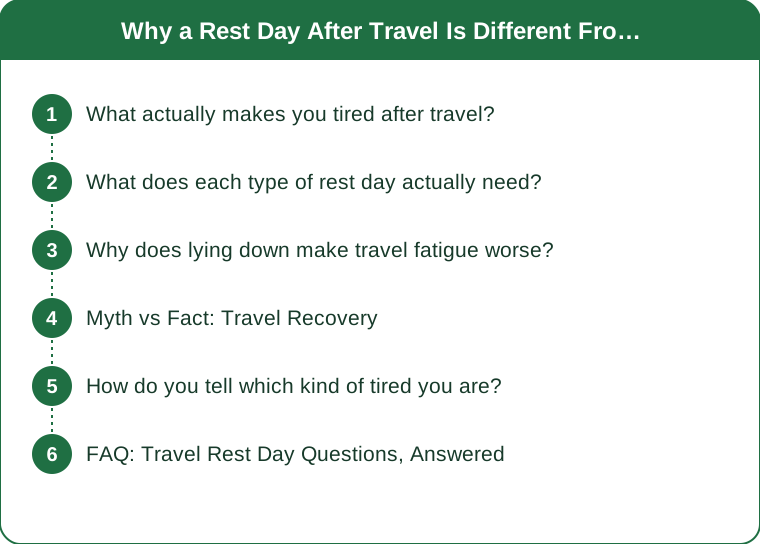
What actually makes you tired after travel?
Four things, none of which are muscle fatigue.
Circadian disruption. Even without crossing time zones, travel disrupts sleep timing, light exposure, and meal timing. Your internal clock is coordinated by light more than anything else, and travel scrambles the signal. This is the largest component and the slowest to resolve.
Dehydration. Cabin air is extremely dry, and people drink less water and more coffee and alcohol when traveling. Mild dehydration produces fatigue, headache, and poor concentration.
Prolonged immobility. Hours seated reduces circulation, causes fluid to pool in the lower legs, and produces the stiffness and heaviness people describe as feeling swollen. Sitting still is itself fatiguing, which is counterintuitive and well established.
Cumulative low-grade stress. Navigation, noise, unfamiliar beds, schedule pressure, and disrupted eating all add up.
What is notably absent: muscle damage, glycogen depletion, and central nervous system fatigue from training. Which is why the recovery tools that work after a hard session do very little here.
What does each type of rest day actually need?
Almost opposite prescriptions, which is the whole point.
After hard training:
- Light movement — a 20 to 30 minute walk, easy mobility. Enough to promote blood flow, not enough to add stimulus
- Adequate food, especially carbohydrate and protein. You are replenishing and repairing
- Sleep priority. This is when adaptation happens
- Genuine rest is appropriate. Sitting down is fine and often correct
- Timeline: 24 to 72 hours depending on the session
After travel:
- Substantially more movement. A long walk, ideally outdoors in daylight. This is the single most effective thing and it is the opposite of what you feel like doing
- Aggressive hydration, with electrolytes if you have been flying or drinking
- Light exposure at the right time — morning daylight to anchor your clock, dim evening light to let melatonin rise
- Meal timing back on local schedule immediately, even if you are not hungry at the right times
- A normal bedtime, resisting the nap that feels essential
- Timeline: roughly a day per time zone crossed for full circadian realignment, and one to two days for the rest
Why does lying down make travel fatigue worse?
Because it extends the immobility that caused a good part of the problem, and it reinforces the circadian disruption.
The immobility side is straightforward: another day of sitting continues the circulatory stagnation and stiffness, and does nothing to clear the fluid pooling in your legs. Movement is the mechanism that resolves both, and you have chosen not to use it.
The circadian side is more consequential. A long daytime nap reduces sleep pressure in the evening, so you sleep badly that night, wake unrefreshed, and extend the disruption by another day. The nap feels essential and buys you an afternoon at the cost of the following two days.
Staying indoors compounds it. Indoor light is roughly a hundred times dimmer than outdoor daylight even on a cloudy day, and light is the primary signal your clock uses. A day spent inside gives your body almost no information about what time it is.
The rule that follows: after travel, the rest day should be an outdoor day. Twenty minutes of morning daylight and a long afternoon walk does more than any amount of lying down.

Myth vs Fact: Travel Recovery
Myth: You should sleep as much as possible to catch up. Fact: Sleeping in and napping both delay circadian realignment. A normal wake time with morning light exposure resolves it faster, even though the first morning is unpleasant. Sleep debt is real and gets repaid over several normal nights, not one long one.
Myth: Travel fatigue means you need a full rest week. Fact: Your muscles are not fatigued — you did not train. Light training the day after travel is usually fine and often helps, particularly anything outdoors. What is worth deferring is a hard or technical session, since coordination and reaction time are genuinely impaired.
Myth: Compression socks are a gimmick. Fact: For long seated travel, they have reasonable support for reducing lower-leg swelling and discomfort. They address the immobility component specifically and do nothing for the circadian one.
Myth: You can just push through and train hard the next day. Fact: You can train, and hard sessions performed while sleep-deprived and dehydrated carry a higher injury risk and produce a worse training effect. Easy volume the day after travel and hard work the day after that is the sequence that costs least.
How do you tell which kind of tired you are?
A few reliable distinguishing signs, which matters because people often have both at once after an active trip.
Training fatigue signals:
- Localized muscle soreness, worse with movement of that specific area
- Heavy limbs during exertion, normal at rest
- Appetite up, particularly for carbohydrate
- Sleep is normal or deeper than usual
Travel fatigue signals:
- Generalized heaviness with no specific sore area
- Stiffness rather than soreness, worse in the morning and improving with movement
- Headache, dry mouth, and mild swelling in feet and ankles
- Sleep is disturbed, waking at odd hours, unrefreshing
- Brain fog disproportionate to physical tiredness
If you have both — an active holiday, hiking abroad, a race weekend away — treat the travel component first. Movement, water, and daylight do not interfere with training recovery, and they resolve the component that would otherwise drag on for days. Then take a genuine training rest day once your clock is back.
As general information rather than medical advice: significant one-sided calf swelling, pain, or warmth after long travel is not ordinary travel fatigue and warrants prompt medical attention rather than a walk.
FAQ: Travel Rest Day Questions, Answered
How long does jet lag actually take to resolve?
A commonly cited estimate is about a day per time zone crossed, and eastward travel is generally harder than westward because it requires advancing your clock rather than delaying it. Morning light after eastward travel and evening light after westward travel both speed it up.
Should I train on the day I arrive?
Light activity on arrival day is usually helpful — a walk, easy mobility, some daylight. It counters the immobility and helps anchor your clock. A hard session on arrival day is generally a poor trade.
What about the rest day I would have taken anyway?
If your program had a rest day scheduled and you have just traveled, you have two different needs on the same day and they conflict. The workable answer is a walking-heavy outdoor day — it satisfies the training rest day’s requirement for light movement and the travel day’s requirement for daylight and circulation at the same time.
TL;DR:
- Training fatigue is muscle damage and depletion; travel fatigue is circadian disruption, dehydration, and immobility
- Lying down helps the first and actively prolongs the second
- After travel: long outdoor walk, morning daylight, aggressive hydration, normal bedtime, no nap
- Distinguish them by whether the tiredness is localized and sore, or general and stiff with brain fog
Both days end with you doing no training. What you do with the other fifteen hours is completely different, and getting it backwards is why the day off after a trip so often leaves you worse than before.
Keep Reading
This article is for general informational purposes only and is not medical advice. Always consult a qualified health professional for guidance specific to you.