Why a Rest Day Feels Different Depending on What You Actually Do With It
Quick Answer: A rest day spent on genuinely restorative activities (light movement, adequate sleep, time outdoors) tends to leave you feeling more recovered than a rest day spent entirely sedentary and screen-heavy, because passive inactivity doesn’t support circulation and stress recovery the way light activity does — the deciding factor is what fills the day, not simply the absence of training.
No workout either day — same technical definition of ‘rest day’ — and yet one leaves you feeling loose and ready, while the other leaves you feeling stiffer and somehow more tired than the training days around it. That’s not a coincidence.

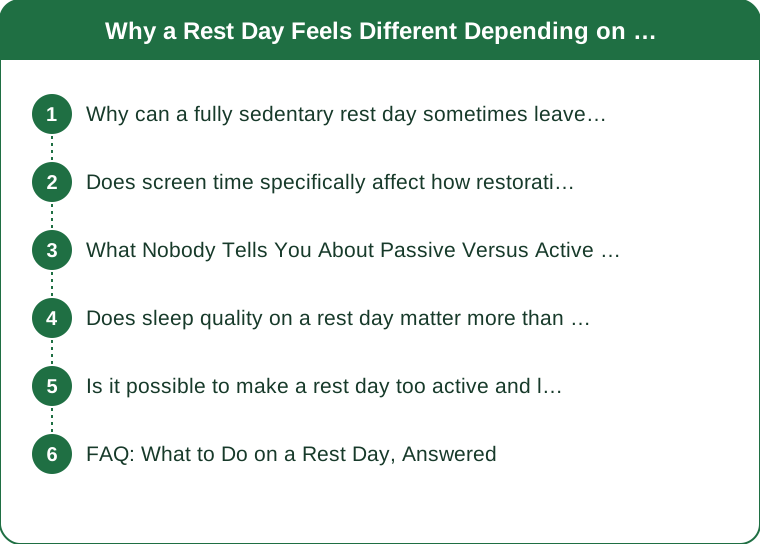
Why can a fully sedentary rest day sometimes leave the body feeling worse than a light-activity one?
Complete inactivity reduces circulation compared to light movement, and reduced blood flow slows the clearance of metabolic byproducts from previous training sessions and can leave muscles feeling stiffer rather than more recovered; a day of light walking or gentle stretching keeps circulation moving without adding meaningful training stress, which tends to support recovery more effectively than a fully still day.
Does screen time specifically affect how restorative a rest day feels?
Extended screen time, especially scrolling, tends to keep the nervous system in a low-grade alert state rather than allowing the parasympathetic ‘rest and digest’ state that supports actual physical and mental recovery, meaning a rest day spent mostly on a phone or screen can feel less mentally and physically restorative than the same amount of time spent on calmer, screen-free activities, even without any exercise involved.
What Nobody Tells You About Passive Versus Active Rest
Most rest day advice draws a simple binary between ‘training’ and ‘not training,’ but nobody tells you that within the ‘not training’ category, there’s a meaningful difference between active rest (light walking, gentle stretching, time outdoors) and passive rest (sitting, screens, minimal movement) — the two can produce noticeably different recovery outcomes despite both technically counting as a rest day.

Does sleep quality on a rest day matter more than what happens during waking hours?
Sleep is arguably the single largest recovery factor regardless of how the rest day itself is spent, and a rest day with poor sleep the night before or after will generally feel less restorative than one with solid sleep, even if daytime activity choices were otherwise ideal — meaning sleep and daytime activity choice both matter, but sleep often has the larger individual effect.
Is it possible to make a rest day too active and lose the recovery benefit?
Yes — the line between light active rest and accidentally adding real training stress can blur, especially with activities like a long, brisk hike or an intense yoga class that technically isn’t ‘training’ but still creates meaningful physical demand; keeping rest day activity genuinely light and low-intensity (a slow walk rather than a fast one, gentle stretching rather than a deep flexibility session) preserves the actual recovery purpose of the day.
FAQ: What to Do on a Rest Day, Answered
What counts as good active rest without risking overtraining?
A slow-paced walk, gentle stretching, easy swimming, or light yoga generally stay light enough to support recovery without adding meaningful training stress, as long as effort stays noticeably below normal workout intensity.
Is it fine to have a fully sedentary rest day occasionally?
Occasionally, yes — the concern is more about a consistent pattern of fully passive, screen-heavy rest days rather than any single one, since one sedentary day among an otherwise varied recovery routine isn’t likely to cause a noticeable difference.
Does time outdoors specifically add recovery benefit beyond just light movement indoors?
Some research suggests time outdoors supports stress recovery and mood beyond the physical activity itself, meaning a walk outside may offer a modest additional benefit compared to the same light movement done indoors, though both are better than no movement at all.
TL;DR:
- Fully sedentary rest days can leave muscles feeling stiffer due to reduced circulation compared to light activity
- Extended screen time can keep the nervous system alert rather than in a restorative state
- Sleep quality is often the single largest factor in how restorative a rest day feels
- Rest day activity should stay genuinely light — overly active ‘rest’ can blur into real training stress
A rest day and a rest day aren’t automatically the same thing — what fills the hours in between matters almost as much as skipping the workout itself, and a little light movement usually beats total stillness.
Keep Reading
This article is for general informational purposes only and is not medical advice. Always consult a qualified health professional for guidance specific to you.