Why a Rest Day Spent Scrolling Can Leave You More Tired Than One Spent Walking
Quick Answer: Passive rest spent scrolling or sitting for long stretches can leave muscles stiff and circulation sluggish while also providing low-quality mental rest from constant screen stimulation, whereas a light walk keeps blood flow moving and often provides more genuine mental disengagement — meaning true recovery quality, not just lack of exercise, is what actually determines how restored a rest day feels.
Rest day fatigue isn’t really about whether you exercised — it’s about whether your body and mind actually got to recover.

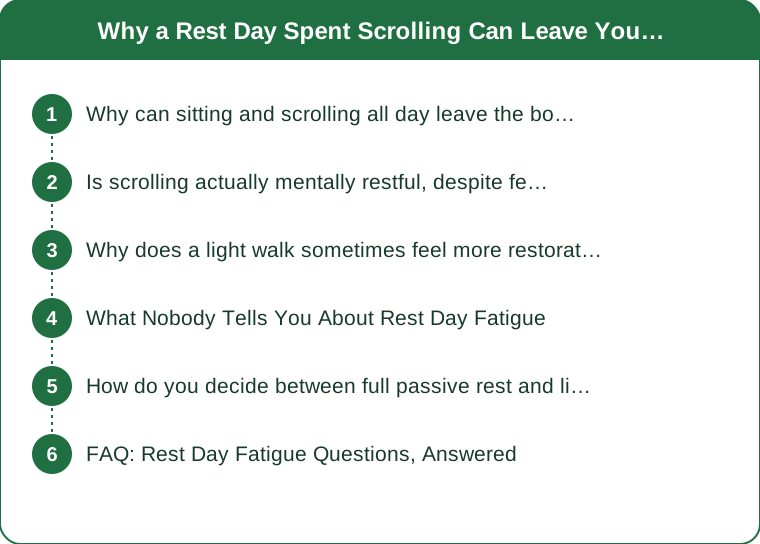
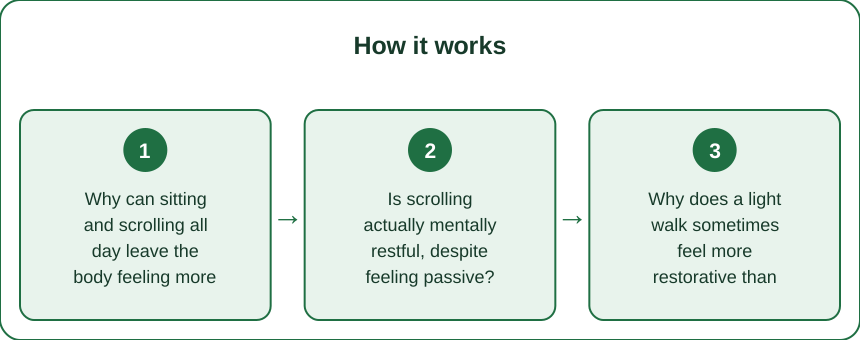
Why can sitting and scrolling all day leave the body feeling more sluggish?
Extended sitting reduces circulation and can allow mild stiffness to set in, particularly after a hard training block when muscles benefit from at least some gentle movement to help clear metabolic byproducts and maintain blood flow — a fully sedentary rest day skips this and can leave muscles feeling heavier and stiffer than expected by the next day.
Is scrolling actually mentally restful, despite feeling passive?
Not especially — screen scrolling, particularly through social media or news, involves constant low-level cognitive engagement and frequent context-switching between unrelated content, which doesn’t provide the kind of genuine mental disengagement that actual rest requires, even though it feels physically passive.
Why does a light walk sometimes feel more restorative than doing nothing?
A light walk keeps circulation active, provides mild, non-demanding physical movement that supports recovery rather than working against it, and — especially outdoors — offers a genuine break from screens and cognitive load, combining physical and mental recovery benefits that pure inactivity doesn’t provide on its own.

What Nobody Tells You About Rest Day Fatigue
The assumption that any day without a workout automatically counts as ‘rest’ skips over the fact that rest quality varies enormously based on what actually happens during it. A day spent in low-grade stress (work stress, doom-scrolling, poor sleep the night before) while also skipping exercise can leave someone more fatigued than a day that included a structured, easy 20-minute walk and genuine mental downtime — the presence or absence of a workout is a much smaller factor in how restored someone feels than most people assume.
How do you decide between full passive rest and light active recovery on a given day?
Genuine physical fatigue, soreness, or illness are reasonable signals to lean toward fuller passive rest, while general tiredness without significant soreness often responds better to light movement like walking, since it addresses circulation and mental disengagement without adding meaningful training stress.
FAQ: Rest Day Fatigue Questions, Answered
Is it ever better to do absolutely nothing on a rest day?
Yes — after genuinely intense training blocks, illness, or significant fatigue, full passive rest without added movement is the more appropriate choice, and pushing a walk in that state can work against recovery rather than supporting it.
How long should a light recovery walk be to make a difference?
Even 15-20 minutes at an easy, conversational pace is typically enough to support circulation and provide a mental break, without adding meaningful physical training stress.
Does time outdoors specifically matter, or does any walk work?
Outdoor walks tend to provide an additional mental reset (natural light, changing scenery) compared to indoor walking, though any walk that gets someone away from a screen and moving lightly still offers most of the same core benefits.
TL;DR:
- Passive rest doesn’t automatically mean high-quality recovery
- Extended sitting can leave muscles stiffer through reduced circulation
- Screen scrolling provides low-quality mental rest despite feeling physically passive
- Light walking supports both circulation and genuine mental disengagement
- The choice between full rest and light movement should follow actual fatigue and soreness levels
A true rest day is about recovery quality, not just the absence of a workout.
Keep Reading
This article is for general informational purposes only and is not medical advice. Always consult a qualified health professional for guidance specific to you.