Why Two Rest Days in a Row Can Beat Spacing Them Out
Quick Answer: Recovery from accumulated training stress isn’t only about muscle repair — it includes nervous system and hormonal recovery, which respond to sustained low-stress periods rather than single days. Two consecutive rest days can allow a deeper recovery cycle than two isolated days, particularly during heavier training blocks.
Everybody spaces rest days out. It’s the obvious approach and it’s often not the better one — especially if you keep arriving at every session feeling slightly flat.

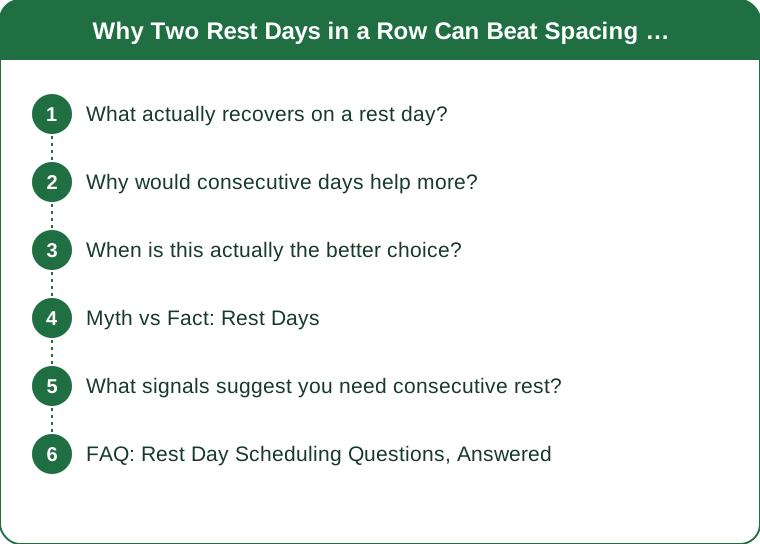
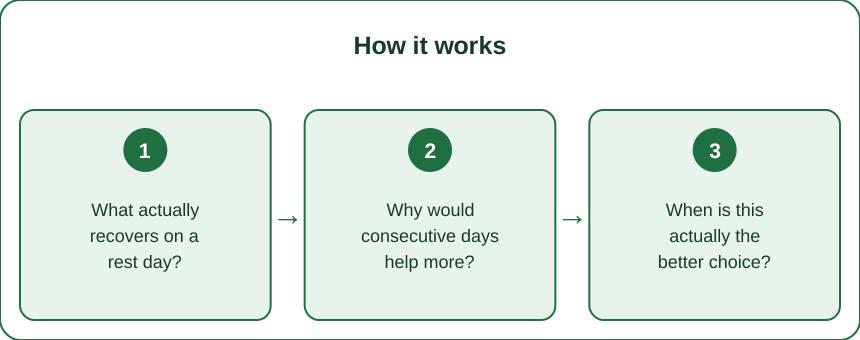
What actually recovers on a rest day?
Several systems on different timelines. Muscle protein synthesis remains elevated for roughly 24-48 hours after a training session. Glycogen replenishment takes about 24 hours with adequate carbohydrate intake.
But nervous system recovery and hormonal normalization operate on a longer and less precise timeline, particularly after heavy or high-volume work. A single rest day may be enough for the fast systems while leaving the slower ones incompletely recovered — which is what accumulates over weeks into that persistent, hard-to-name flatness.
Why would consecutive days help more?
Because sustained low-stress periods allow more complete recovery of the slower systems than interrupted ones do. Two isolated rest days both get interrupted before the second night’s sleep contributes to the same continuous window.
Sleep is where a substantial share of recovery happens, and two consecutive nights without training stress on either side gives you a genuinely different recovery block than two nights separated by a hard session. This is part of the logic behind how many structured programs place their rest days.
When is this actually the better choice?
In specific situations rather than universally. Consecutive rest tends to help when you’re training four or more days a week at meaningful intensity, when you’re in a heavier block, or when accumulated fatigue is showing up as persistently flat sessions.
Spaced rest generally works better for lower frequencies — three sessions a week alternating with rest is a sound structure — and for people whose main constraint is habit consistency rather than recovery capacity. If two days off in a row makes it harder to come back, that’s a real cost worth weighing.

Myth vs Fact: Rest Days
Myth: Rest days should always be spaced evenly. Fact: Even spacing is a convention rather than a physiological requirement. Placement should follow the training block’s demands.
Myth: Two days off means losing fitness. Fact: Detraining takes considerably longer than two days. Nothing measurable is lost.
Myth: Active recovery is always better than complete rest. Fact: Light movement helps in many cases, but during high accumulated fatigue, genuine rest is sometimes what’s actually needed. Active recovery is still a stressor, just a small one.
Myth: If you’re not sore, you don’t need a rest day. Fact: Soreness measures muscle damage, which is one input among several. Nervous system fatigue frequently shows up without any soreness at all.
What signals suggest you need consecutive rest?
The reliable ones cluster around performance and recovery rather than around how motivated you feel. Multiple sessions in a row where the same weight feels heavier than usual. Elevated resting heart rate over several days. Sleep quality declining without an obvious cause. Persistent low motivation that isn’t explained by anything else in life.
Any one of those alone is noise. Two or three together over a week is a reasonably strong signal that the fast systems are fine and the slow ones aren’t — and that’s precisely the situation consecutive rest addresses better than an extra spaced day would.
FAQ: Rest Day Scheduling Questions, Answered
Should the two days be a weekend?
Whatever fits your schedule. The physiological benefit comes from consecutiveness, not from which days they land on.
Can I do light activity on consecutive rest days?
Walking and gentle mobility are generally fine and often helpful. The point is removing the training stress, not eliminating movement.
How often should I take two in a row?
Many programs build in a lighter week roughly every fourth to sixth week. Outside of that, use it responsively when the fatigue signals show up rather than on a fixed schedule.
TL;DR:
- Different recovery systems operate on different timelines; the slow ones need longer windows
- Two consecutive rest days can allow deeper recovery than two spaced ones
- Most useful at four-plus sessions a week or during heavy blocks
- Watch for heavier-feeling weights, elevated resting heart rate, and declining sleep
- Nothing is lost in two days off — detraining takes far longer
Spacing rest days evenly is a convention, not a rule. If sessions have felt flat for a week, try putting the two together and see what the next one feels like.
Keep Reading
This article is for general informational purposes only and is not medical advice. Always consult a qualified health professional for guidance specific to you.