Why You Sleep Worse on Rest Days
Quick Answer: Sleep depends on two systems: how long you have been awake and how strongly your body clock is signalling night. Exercise strengthens both - it builds sleep pressure and it anchors the circadian rhythm through movement, light exposure, and a body temperature rise that falls again hours later. A rest day usually removes all three at once, which is why you can feel tired and still not sleep. The fix is not more exercise; it is replacing the signals with a short walk, daylight, and a consistent schedule.
The intuitive model - tired body, good sleep - is only a small part of how this works.
The signals matter more than the fatigue.

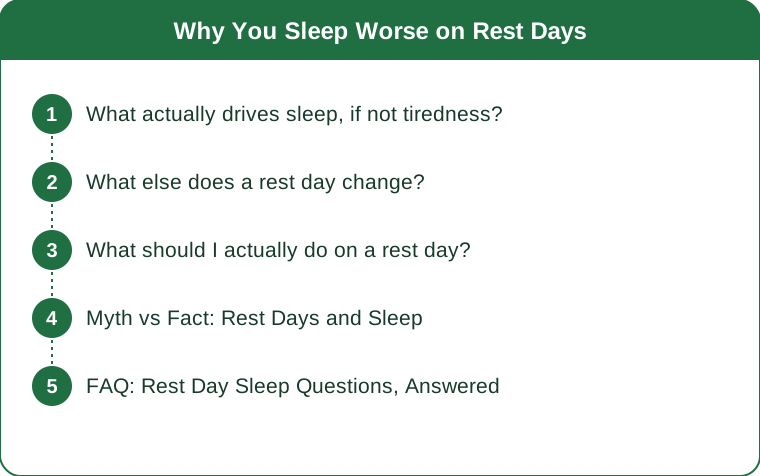
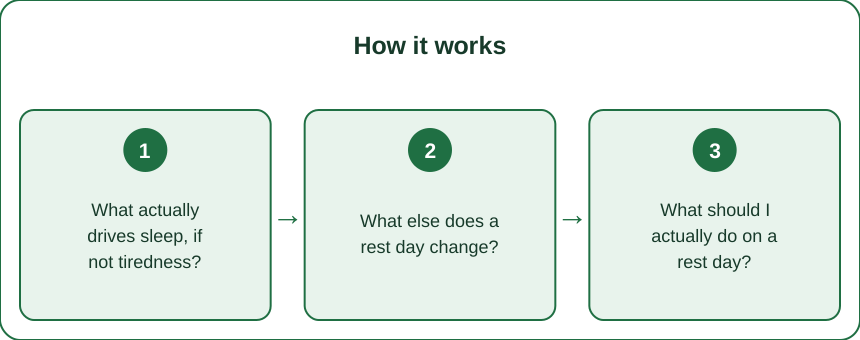
What actually drives sleep, if not tiredness?
Two processes, and exercise supports both.
Sleep pressure builds with time awake. A chemical called adenosine accumulates through the day and is cleared during sleep. More activity means more energy use and more adenosine, which is one mechanism by which a training day helps.
The circadian system is the other half, and it is the bigger factor here. Your body clock is set primarily by light, and secondarily by activity, meal timing, and temperature. It determines when you feel sleepy, largely independent of how tired you are.
Exercise supports the clock in three ways. It usually takes place at a consistent time, which is a timing cue. It typically involves light exposure, especially outdoors. And it raises core body temperature, which then falls over the following hours - and a falling core temperature is one of the strongest sleep-onset signals your body has.
A rest day removes all three simultaneously. No temperature rise, less light exposure, and often a shift in schedule - later start, more time indoors, meals at different times.
Which is why you can feel genuinely tired and still not fall asleep. Sleepiness and sleep pressure are not the same thing, and it is the clock, not the fatigue, that decides when you drift off.
What else does a rest day change?
Several things, all pointing the same direction.
Less daylight. Training often gets you outdoors, or at least out of the house. Morning light exposure is the single strongest signal for setting the body clock, and a rest day spent indoors can mean a fraction of the light exposure of a training day.
Different schedule. Rest days frequently involve a later wake time, which shifts the whole clock later and makes falling asleep at your usual time harder. A weekend lie-in produces a version of jet lag.
More screens and more evening light. With unfilled time, evening screen use often rises. Light in the evening suppresses melatonin and pushes the clock later - the opposite of what morning light does.
Different caffeine timing. Without a training session to structure the day, afternoon coffee is more likely. Caffeine has a half-life of roughly five to six hours, so a three o’clock coffee is still meaningfully present at bedtime.
And a stress-recovery effect that catches endurance athletes out. After a hard training block, sympathetic nervous system activity can remain elevated, producing a wired-but-tired sensation on the rest day. Elevated resting heart rate alongside poor sleep is the classic signature and is worth taking seriously as a sign of accumulated fatigue.
None of these is large alone. Together they are more than enough to change a night’s sleep.

What should I actually do on a rest day?
Replace the signals without replacing the training. Five things, none demanding.
1. Get outside within an hour of waking. Ten to twenty minutes of morning daylight is the highest-value intervention available and it is free. Even an overcast morning provides far more light than any indoor room.
2. Keep the wake time the same. A consistent wake time is more important than a consistent bedtime for stabilising the clock. Sleeping in on rest days is the most common self-inflicted cause of a bad night.
3. Take a twenty to thirty minute walk. Ideally at roughly the time you would normally train. This supplies a mild temperature rise, light exposure, and the timing cue - all three signals, in half an hour, at almost no physiological cost.
4. Keep meal timing consistent. Meal times are a secondary clock cue, and eating dinner two hours later than usual shifts things.
5. Cut caffeine by early afternoon. Roughly eight hours before bed is a reasonable rule given its half-life. Rest days are when this slips.
And one to consider if you are wired rather than tired: a warm bath or shower ninety minutes before bed. The subsequent drop in core temperature mimics the post-exercise pattern and is reasonably well supported as a sleep aid.
Notice that none of these is exercise. You are not undoing the rest day - you are restoring the signals that happen to travel with training.
Myth vs Fact: Rest Days and Sleep
Myth: You sleep badly on rest days because you are not tired enough. Fact: Sleep is driven more by circadian signals than by physical fatigue. The missing light, timing, and temperature cues matter more than the missing exertion.
Myth: Exercising in the evening ruins sleep. Fact: For most people, evening exercise does not impair sleep and may improve it, provided it finishes an hour or so before bed. The old advice was based on weak evidence and has been substantially revised.
Myth: Making up sleep on the weekend fixes a bad week. Fact: Some recovery is possible, but the schedule shift creates its own problem - a two-hour lie-in on Sunday makes Sunday night worse and Monday harder.
Myth: If you cannot sleep, stay in bed and rest. Fact: Lying awake for extended periods weakens the association between bed and sleep. Standard guidance is to get up after roughly 20 minutes and do something quiet in dim light until sleepy.
Myth: Poor sleep on one rest day means overtraining. Fact: One night is noise. Persistently poor sleep alongside elevated resting heart rate, low motivation, and declining performance is a pattern worth acting on - a single night is not.
FAQ: Rest Day Sleep Questions, Answered
Should I nap on rest days?
A short nap of 20 to 30 minutes early in the afternoon is generally fine. Longer or later naps reduce sleep pressure enough to interfere with the night, which on a rest day you can least afford.
Is it bad to do light activity on a rest day?
No - a walk, easy mobility work, or gentle movement is active recovery and is generally beneficial. A rest day means no training stress, not no movement. The walk is the point of this entire article.
Why do I sleep worst after the hardest training day?
High-intensity training can leave sympathetic nervous system activity elevated for hours. Finishing hard sessions earlier in the day, and including a proper cool-down, both help. If it happens consistently after every hard session, total training load may be too high.
TL;DR:
- Sleep runs on sleep pressure and circadian signals, and exercise supports both.
- A rest day removes the light exposure, the timing cue, and the temperature rise all at once.
- Keep the wake time constant - more important than a constant bedtime.
- Twenty to thirty minutes outdoors at your usual training time restores all three signals.
- Watch caffeine timing and evening screens, which both drift on unstructured days.
Tomorrow, if it is a rest day, get outside for twenty minutes at the time you would normally train.
Keep Reading
This article is for general informational purposes only and is not medical advice. Always consult a qualified health professional for guidance specific to you.