Why Your Rest Day Is on the Wrong Day of the Week
Quick Answer: Rest days should be placed where fatigue is highest and where your schedule is worst, not where the calendar suggests. For most people that means a rest day mid-week rather than only at the weekend, because three or four consecutive training days accumulate more fatigue than the weekend break can clear. Placing rest after your hardest session, and on your busiest work day, gets far more out of the same number of rest days.
Sunday is the default because it is culturally the day off, not because it is when your body needs it.
This blog has covered why two rest days in a row can beat spacing them out and why your rest day needs walking rather than nothing. This is the placement question, which is the one that changes results without changing your training volume at all.

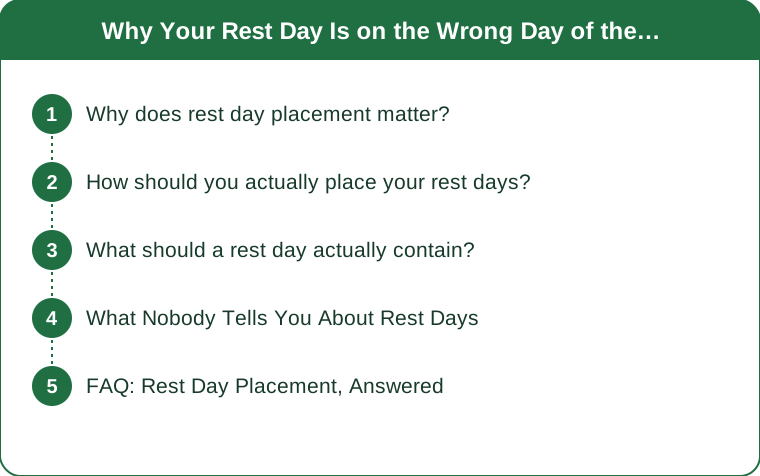
Why does rest day placement matter?
Because fatigue accumulates within a week and recovery is not uniform.
Consecutive training days compound. Each session leaves residual fatigue, and by day three or four of consecutive training, the quality of your sessions is measurably lower even though your effort is the same or higher.
Poor-quality sessions produce fatigue without producing adaptation. This is the core problem. A session done in a fatigued state costs you the same recovery and delivers less benefit, which is the worst possible trade.
Different systems recover at different rates. Your cardiovascular system recovers quickly, muscle takes longer, and connective tissue and the nervous system take longer still. A single day off does not restore all three equally.
Placement decides which sessions get the benefit. A rest day before your most important session means you arrive fresh for the one that matters most. A rest day after it means you arrived tired.
And most people’s week is not symmetrical. Work stress, sleep quality, and available time vary a great deal by day, and aligning your rest day with your worst day makes the whole week easier without changing training volume.
The practical upshot is that the same three training days and one rest day can produce noticeably different outcomes depending purely on order.
How should you actually place your rest days?
By three rules, applied in this order.
1. Never train hard more than three consecutive days. For most people training four to six times a week, this means a break after every two or three sessions rather than a block of five followed by two off.
2. Rest before your most important session, not after. If one session a week matters most, arrive at it fresh. This single change often improves that session more than any programming adjustment.
3. Align a rest day with your worst schedule day. If Wednesday is reliably chaotic at work, make Wednesday the rest day. Trying to train on your worst day and rest on your easiest is fighting your own calendar every week.
A workable four-day pattern: train Monday and Tuesday, rest Wednesday, train Thursday and Friday, rest or move gently at the weekend.
A workable five-day pattern: train Monday and Tuesday, rest Wednesday, train Thursday, Friday, and Saturday, rest Sunday.
And adjust by how sessions actually feel rather than sticking to the grid. Two poor sessions in a row is a signal to move the rest day forward, not to push harder. The plan is a default, not an obligation.

What should a rest day actually contain?
Movement, not nothing, and specifically low-intensity movement.
Complete inactivity is not optimal recovery for most people. Gentle movement increases blood flow, which supports the delivery of nutrients to recovering tissue and helps clear the by-products of training.
A 20 to 40 minute easy walk is the standard recommendation and it is genuinely effective. Easy means conversational, not brisk exercise in disguise.
Add mobility work if you will actually do it. Ten minutes on whatever is stiffest is more valuable on a rest day than tacked onto the end of a training session when you are tired and want to leave.
Sleep is the real recovery intervention and everything else is secondary. A rest day with poor sleep recovers you considerably less than a training day with good sleep. If you change one thing, change that.
Do not reduce your food on rest days. Recovery and tissue repair happen on rest days, which is exactly when the raw materials are needed. Protein in particular should stay the same or go slightly up, which is covered in more depth on the protein blog in this network.
And be honest about what an active recovery session is. A hard yoga class, a long hike, or a fast bike ride is training. Calling it recovery does not change what it costs you, and it is the most common way people end up training seven days a week while believing they rest twice.
What Nobody Tells You About Rest Days
Two consecutive rest days are sometimes better than two spread out, particularly if you are training hard or juggling a demanding schedule. Connective tissue and the nervous system recover on slower timelines that a single day does not fully address.
You often sleep worse on rest days, which surprises people who expect the opposite. Reduced physical fatigue plus an unchanged bedtime is usually the explanation, and it is a topic worth its own attention.
Appetite is frequently higher on rest days, largely because appetite signalling lags training by a day. This is normal and it is not a sign of anything going wrong.
Motivation to train is often highest on the rest day, which is a well-known trap. Taking the rest day when you feel great is exactly what allows you to feel great in the next session too.
Life stress counts as load. A brutal week at work does not leave your recovery capacity untouched, and adding an extra session in a high-stress week is often a net negative regardless of how the training itself feels.
And more training is not what most people are short of. Most people who feel stuck are under-recovered rather than under-trained, and the fastest available improvement is usually a better-placed rest day rather than an extra session.
FAQ: Rest Day Placement, Answered
How many rest days do I need per week?
Typically one to three depending on training intensity and life stress. Placement matters at least as much as the number, and no more than three consecutive hard training days is the more useful rule.
Should I rest before or after my hardest session?
Before. Arriving fresh at your most important session improves it more than almost any programming change, and resting afterwards means you had already trained it tired.
What should I do on a rest day?
A 20 to 40 minute easy walk plus optional mobility work. Complete inactivity is not optimal, and anything that leaves you breathing hard is training rather than recovery.
TL;DR:
- Rest day placement changes results without changing training volume, and almost nobody places it deliberately.
- Never train hard more than three consecutive days, rest before your most important session, and align rest with your worst schedule day.
- Rest days should include a 20 to 40 minute easy walk, not complete inactivity, and food should not be reduced.
- Two consecutive rest days are sometimes better than two spread out, particularly under high life stress.
If you feel stuck, move your rest day before you add a session. It is free and it usually works.
Keep Reading
This article is for general informational purposes only and is not medical advice. Always consult a qualified health professional for guidance specific to you.