Why Your Rest Day Needs Walking, Not Nothing
Quick Answer: Light movement increases blood flow to recovering muscle, helps clear metabolic byproducts, maintains joint mobility, and reduces the stiffness that makes a rest day feel worse than a training day. Twenty to forty minutes of easy walking — genuinely easy, conversational, no pace target — consistently leaves people feeling better the next day than complete stillness does. Total rest has its place, but it should be the exception.
You trained hard yesterday, so today you did nothing at all. And somehow you feel stiffer and flatter than you did before.
Complete rest and recovery are not synonyms. Recovery is an active biological process, and it works better when blood is moving.
Here is what light movement does and how little you need.

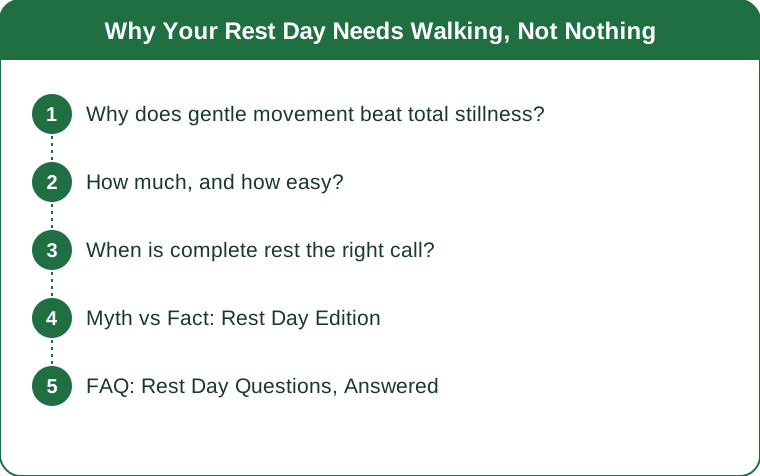
Why does gentle movement beat total stillness?
Because most of what recovery requires is delivered by circulation.
Blood flow brings what repair needs. Oxygen, amino acids, and glucose reach damaged tissue through circulation. Light activity raises muscle blood flow substantially above resting without adding meaningful new stress.
It helps clear byproducts. Movement assists the removal of metabolic waste and the resolution of the mild inflammatory response to training. Sitting still slows that.
It keeps joints and fascia moving. Prolonged stillness after hard training reliably increases stiffness. Twenty minutes of walking does more for next-day range of motion than any amount of sitting.
And the mood effect is real. Light activity reliably improves mood and perceived energy, whereas a fully sedentary day after hard training often leaves people feeling worse. Much of what people call a bad rest day is simply the stiffness and flatness of doing nothing.
How much, and how easy?
Twenty to forty minutes, at an effort you would not call exercise.
Conversational is the ceiling. If you could not chat comfortably, it is too hard for a rest day. Aim for something around 2 to 3 on a 10-point effort scale.
No pace, no target, no watch. The moment you are chasing a number it stops being recovery. Leave the watch at home — this is the one session where data actively works against the purpose.
Split it if that is easier. Two fifteen-minute walks work as well as one thirty-minute walk, and fit around a day more easily.
Add gentle mobility if you like. Five to ten minutes of easy range-of-motion work is a good pairing. Deep stretching into discomfort is not — it is another stressor on a day designed to have none.

When is complete rest the right call?
When you are ill, genuinely exhausted, or coming off an unusually heavy block.
Illness means rest. Fever, chest symptoms, or systemic illness are straightforward reasons to do nothing. Walking through those is a bad trade.
Deep fatigue after a peak. After a race, a competition, or an unusually hard training block, one or two fully passive days can be exactly right.
Sleep debt outranks a walk. If the choice is a walk or an extra hour of sleep, take the sleep. Sleep is the highest-leverage recovery tool by a wide margin and it wins every direct comparison.
And if your legs feel genuinely heavy, walk shorter. Ten easy minutes still helps. The failure mode is not resting too little — it is turning a recovery walk into a session because it felt good after ten minutes.
Myth vs Fact: Rest Day Edition
Myth: Muscles grow on rest days, so any activity interferes. Fact: adaptation does happen during recovery, and light movement does not interfere with it. What interferes is additional hard training.
Myth: Stretching is the best rest-day activity. Fact: gentle mobility is fine, but walking does more for circulation and stiffness. Aggressive stretching on a sore day is another stressor, not recovery.
Myth: A recovery run is the same as a walk. Fact: for many people an easy run is still meaningful training stress. Walking is genuinely low-cost; easy running frequently is not, especially in the days after hard work.
Myth: If you are sore, do not move. Fact: light movement typically reduces soreness. It is one of the more consistent findings in the recovery literature.
Myth: Steps do not count as exercise, so they do not matter. Fact: on a rest day, not counting as exercise is precisely the point. Low-intensity daily movement is strongly associated with better health outcomes independent of training.
FAQ: Rest Day Questions, Answered
Does a walk count if it is with the dog or the pram?
Yes. Slower, stop-start walking still delivers the circulation and mobility benefits, which are the point. It is not a training session and does not need to be.
What about swimming or cycling instead?
Both work well if kept genuinely easy — flat, conversational, and time-capped. The risk is that both are easy to accidentally turn into a workout. Walking has the lowest chance of that.
Should I take rest days back to back or spread them out?
It depends on your training. Back-to-back rest days can be more restorative after a hard block, while spreading them out suits steady weekly training. Either way, keeping some light movement on both days is preferable to two fully still ones.
This is general information, not medical advice. Persistent fatigue, unusual soreness, or pain that does not improve with rest is worth having assessed.
TL;DR:
- Recovery depends on circulation, and light movement raises muscle blood flow without adding real stress.
- Gentle activity clears byproducts, preserves range of motion, and reliably improves mood versus a fully still day.
- Twenty to forty minutes of conversational walking is the dose — no pace, no target, no watch.
- Splitting it into two shorter walks works just as well.
- Take genuinely complete rest when ill, deeply fatigued after a peak, or when the alternative is more sleep.
- Keep it easy: the common mistake is letting a recovery walk become a session.
Doing nothing feels like the responsible choice after a hard day, and it is usually the less effective one. A slow twenty-minute walk with no data attached is the cheapest recovery tool you have.
Keep Reading
This article is for general informational purposes only and is not medical advice. Always consult a qualified health professional for guidance specific to you.