Why Your Rest Day Should Not Be the Day After Your Hardest Session
Quick Answer: Complete rest on your sorest day tends to prolong soreness, because light movement increases blood flow and reduces perceived stiffness while total inactivity does not. Delayed-onset soreness peaks 24 to 48 hours after training, and that is exactly when gentle activity helps most. Better placement is a rest day before your hardest session — arriving fresh improves the quality of the session that actually drives adaptation.
Saturday was the hard session. Sunday you are wrecked, so Sunday is the rest day.
Monday you feel worse than Sunday did.
The rest day was in the wrong place.

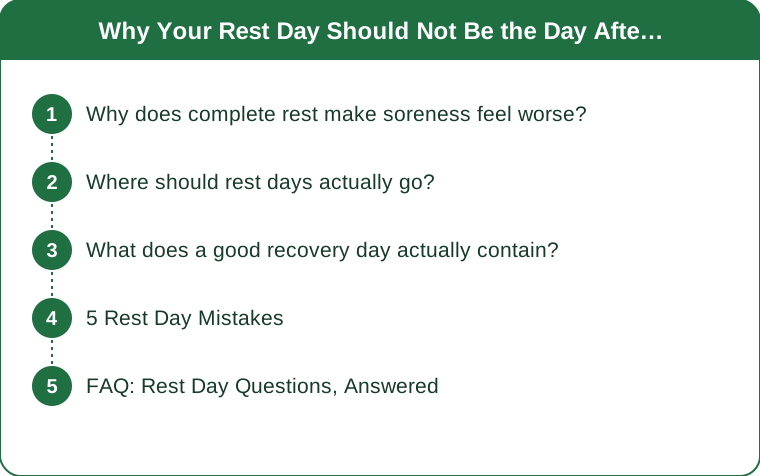
Why does complete rest make soreness feel worse?
Because stiffness and soreness respond to movement, not to stillness.
Soreness peaks at 24 to 48 hours after training, which usually means the day after is the worst day, not the day of.
Light movement increases blood flow to the affected tissue, which is associated with reduced perceived soreness.
Prolonged stillness increases stiffness. Sitting for a full day after a hard session reliably makes the second morning worse.
Movement provides temporary analgesia. Gentle activity genuinely reduces soreness perception during and shortly after.
Complete rest is not the same as recovery. Recovery is a physiological process driven by sleep, nutrition and time. Sitting still contributes little to it beyond avoiding further load.
And it is a perception effect, largely. The evidence for active recovery accelerating actual tissue repair is weak; the evidence for it improving how you feel is much better. Feeling better is still worth having.
Where should rest days actually go?
Placement follows from what each day is for.
Rest the day before your hardest session. Arriving fresh improves the quality of the session that drives most of your adaptation.
Use active recovery on the day after. A 20 to 40 minute walk, easy cycling, gentle mobility. Low intensity, genuinely easy.
Separate similar sessions by 48 hours. Two hard lower-body days back to back is the most common scheduling error there is.
Put the full rest day where life demands it. The best schedule is the one that fits your week. Consistency beats theoretical optimality.
Most people need one to two full rest days weekly, more if training is hard or life is stressful.
And rest days are not fixed forever. Poor sleep, illness or a stressful week all justify moving one. Rigidity is not discipline.

What does a good recovery day actually contain?
More than nothing, less than a workout.
Walking is the highest-value activity. 20 to 40 minutes at conversational pace does most of what active recovery offers.
Gentle mobility rather than aggressive stretching. Moving through comfortable range beats pushing into end range on sore tissue.
Protein intake stays the same. Repair happens on rest days, and this is where most people unnecessarily cut back.
Sleep is the actual recovery intervention. Everything else is marginal by comparison. An extra hour beats every recovery tool on the market.
Hydration matters more than usual. Fluid supports circulation and tissue function during repair.
Seasonal note: as evenings darken, the recovery walk is the first thing to disappear from most people’s weeks. If your soreness has felt worse since the clocks changed, the missing walk is a likely explanation. Moving it to lunchtime keeps it alive through winter.
This is general information, not medical advice.
5 Rest Day Mistakes
Resting completely on the sorest day. Prolongs stiffness. A gentle walk is a better use of that day.
Doing ‘active recovery’ that is actually a workout. If your heart rate is up and you are breathing hard, it is a session. This is extremely common.
Cutting protein on rest days. Repair is happening. Intake should stay the same.
Never taking a full rest day. Some people need one, and pushing through week after week accumulates rather than adapts.
Scheduling rest by soreness rather than by plan. Reactive rest tends to arrive after the damage. Planned rest prevents it.
And the one that catches everyone: counting a busy day on your feet as rest. Eight hours of standing and errands is not a recovery day, even if it was not exercise.
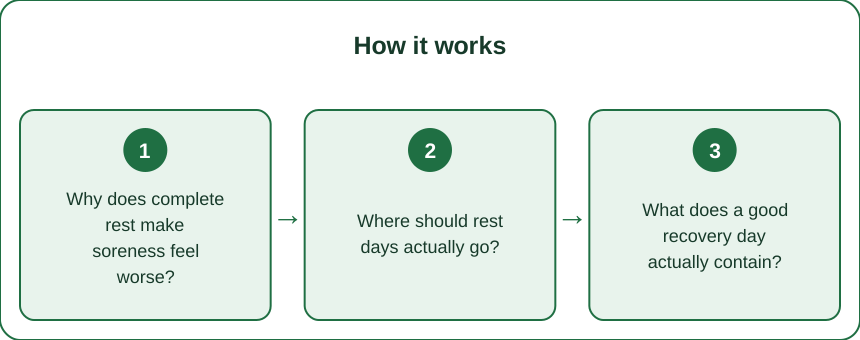
FAQ: Rest Day Questions, Answered
How many rest days do I need?
Most people do well with one to two full rest days weekly, plus lighter days. It depends on training intensity, age, sleep and life stress.
Should I stretch on rest days?
Gentle mobility, yes. Aggressive stretching of sore muscles offers little and can irritate them.
Is walking enough for active recovery?
Yes. 20 to 40 minutes at an easy pace is the core of it, and everything else is optional.
Does soreness mean I need a rest day?
Not necessarily. Mild soreness usually improves with light activity. Sharp pain, or soreness still increasing on day three, deserves a proper rest and possibly assessment.
Can I do cardio on a rest day from lifting?
Easy cardio, yes. Hard intervals, no — that is a training session with a different label.
Should I eat less on rest days?
Not meaningfully. Recovery has an energy cost, and protein in particular should stay constant.
TL;DR:
- Complete rest on the sorest day tends to prolong stiffness; light movement reduces it.
- Place the full rest day before your hardest session and use active recovery after.
- A recovery day is a 20 to 40 minute walk plus gentle mobility — not a disguised workout.
- Keep protein constant on rest days; repair is what those days are for.
- Sleep outperforms every recovery tool, and the darker evenings are when the recovery walk quietly disappears.
Move your rest day to the day before your hardest session this week. Same number of rest days, noticeably better sessions.
Keep Reading
This article is for general informational purposes only and is not medical advice. Always consult a qualified health professional for guidance specific to you.