The Recovery Walk: The Easiest Workout That Isn't One
Quick Answer: Walk 20–40 minutes at a genuinely easy pace — effort around 3 out of 10, conversation completely effortless — the day after hard training. Gentle movement circulates blood through repairing muscle, which consistently outperforms passive rest for soreness in the research. Keep it flat on heavy-leg days and resist every urge to speed up; the drift toward brisk is what ruins it.
The day after leg day offers two options, and your body lobbies hard for the wrong one.
Option one: the couch. Intuitive, appealing, and reliably the slower route out of soreness. Option two: a walk you don’t want to take, which will feel awful for the first four minutes and noticeably better by minute twelve.
That arc — stiff, then looser — isn’t a coincidence or a distraction. It’s the mechanism working in real time.

Does Walking Actually Help Sore Muscles?
Yes, and it’s one of the more consistent findings in the recovery literature.
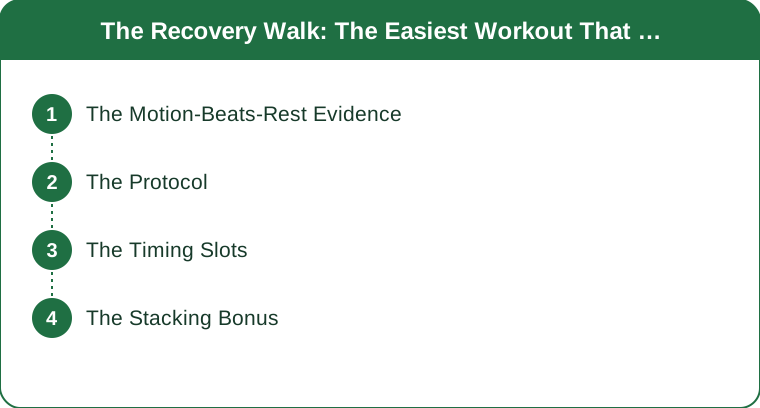
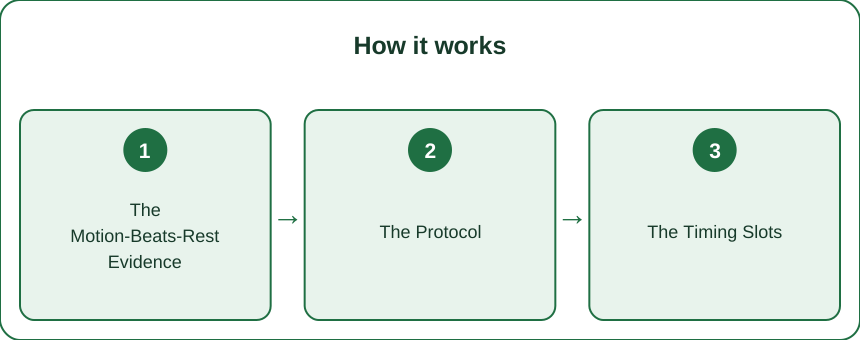
Active recovery — light movement on the day after hard training — repeatedly outperforms passive rest for delayed-onset muscle soreness. The reason is circulatory. Damaged muscle needs supplies in and waste products out, and both of those move on blood flow. Contracting muscles act as a pump; a couch does not.
There’s a second mechanism worth knowing about. Soreness isn’t just tissue damage — a meaningful chunk of it is fluid accumulation and the nervous system turning up sensitivity in the affected area. Gentle movement addresses both: it helps drain the fluid, and it gives your nervous system repeated evidence that the movement is safe, which lowers the guarding response.
What it doesn’t do is speed up the actual repair of the muscle fibers. The soreness was always going to pass on its own timeline — the walk mostly makes the passing more comfortable and gets you moving normally a day earlier. That’s a smaller claim than most recovery marketing makes, and it happens to be true.
What Is the Right Pace and Duration for a Recovery Walk?
20–40 minutes, effort capped at 3 out of 10. That’s the entire protocol.
The pace test that works: you should be able to hold a full conversation without any noticeable change in your breathing. Not “I could talk if I had to” — genuinely effortless. If you find yourself checking a watch or thinking about your split, you’ve already left the zone that does the work.
This walk has exactly one job, and that job is circulation, not fitness. The drift toward brisk is the single most common way people ruin it, because brisk walking on already-damaged legs adds fatigue to a system trying to clear fatigue.
Two other specifics:
- Flat routes on heavy-leg days. Hills load the quads eccentrically on the way down, which is the exact stimulus that made you sore in the first place. The hills can wait 48 hours.
- Twenty minutes is the floor, forty is the ceiling. Below twenty you don’t get enough circulatory effect to notice. Above forty you’re accumulating fatigue rather than clearing it.
If you genuinely can’t face going outside, ten minutes of easy movement around the house still beats zero. The couch-only day is the only actually wrong answer.

When Should You Take a Recovery Walk?
Any slot works, and each one solves a slightly different problem.
Morning after. Best for loosening overnight stiffness before the day sets it in. You wake up worst — sleep means eight hours of no circulation through sore tissue — so a morning walk resets that before you spend the day sitting on it.
Evening. Dissolves what the workday added. If you sat at a desk for eight hours on top of leg day, an evening walk is undoing two problems at once.
Same day, after the hard session. The cooldown’s extended cut. Ten to fifteen minutes of easy walking after training, once your heart rate has come down, preempts a measurable chunk of tomorrow’s worst. This is the highest-value slot and the one nobody uses, because you’re already done and the car is right there.
Pick whichever one you’ll actually do. Consistency beats optimization by a wide margin on something this low-intensity.
5 Recovery Walk Mistakes Everyone Makes
1. Turning it into a workout. Adding a hill, a weighted vest, or a pace target converts recovery into training. You now have two hard sessions in a row and no recovery day.
2. Skipping it because you’re too sore. Being sore is the indication, not the contraindication. The first four minutes will feel bad and then they won’t.
3. Wearing the wrong shoes. A cushioned everyday shoe, not the minimalist trainers or the flat-soled lifting shoes. Your feet and calves are already taxed.
4. Doing it fasted and dehydrated. Not dangerous at this intensity, just miserable, and dehydration is working directly against the circulatory point of the exercise. Water first.
5. Treating it as optional. This is the one that costs the most. It’s the least demanding entry on the entire weekly schedule and the one whose absence tomorrow’s stairs always report.
What Else Can You Stack Onto the Walk?
The recovery walk carries passengers better than almost any other training entry, which is most of why it’s sustainable.
Podcasts and audiobooks. Phone calls to the people you keep meaning to call. The dog, who has been lobbying for this since 6am. Morning sunlight, which does real circadian work — 10–20 minutes of outdoor light early in the day is one of the more reliable sleep-quality interventions available, and sleep is the actual heavyweight in recovery.
That stacking is the point. A 30-minute obligation that also handles your daily light exposure, a phone call, and half a podcast episode isn’t really a 30-minute obligation.
Mini FAQ
Is walking or stretching better for sore muscles?
Walking, for most people. Static stretching has weak evidence for reducing DOMS and can occasionally aggravate freshly damaged tissue if pushed hard. Walking has the circulatory mechanism behind it and no real downside. Gentle mobility work after the walk is a reasonable addition, not a replacement.
Can you do a recovery walk every day?
Yes. At 3-out-of-10 effort it adds essentially no training stress, and daily easy walking has independent benefits for cardiovascular health, mood, and sleep. Most people would be better off walking daily than doing anything else on this list.
How sore is too sore to walk?
Ordinary DOMS — the achy, stiff, tender-to-touch kind — is fine to walk on and improves with it. Sharp pain, pain in a joint rather than a muscle belly, significant swelling, or dark-colored urine after very hard training are different signals entirely and warrant a doctor rather than a walk.
TL;DR:
- Active recovery beats passive rest for soreness because contracting muscles pump blood through repairing tissue.
- 20–40 minutes at 3-out-of-10 effort, conversation completely effortless, flat routes on heavy-leg days.
- The same-day post-training walk is the highest-value slot and the one everyone skips.
- Don’t add hills, pace, or weight — that turns recovery into a second training session.
- Stack it with sunlight, a podcast, or a phone call and it stops feeling like an obligation.
Easy pace, twenty minutes, any slot, couch overruled. The soreness was always going to pass — the walk just files the paperwork a day early.
Keep Reading
This article is for general informational purposes only and is not medical advice. Always consult a qualified health professional for guidance specific to you.